 Skip to content
Stone vs Laminate Benchtop: Which Is Right for Your Kitchen?
Every week, homeowners walk through the Elite Kitchens showroom and ask the same question: stone or laminate? It comes up more than any other material decision, and after more than 30 years in custom cabinetry, I can tell you the honest answer: it depends. Not because that is a cop-out, but because the right benchtop material is genuinely different for a young family staying long-term in their forever home versus a property investor looking to sell quickly in a competitive market. Both materials have a real place in the Australian kitchen. This stone vs laminate benchtop comparison guide will walk you through the real costs, performance differences, maintenance realities, and resale implications so you can make that call with confidence.
The comparison really comes down to three things: how hard your household is on a kitchen, how long you plan to stay in the home, and what your local property market expects from a renovated kitchen. Get clear on those and the material choice becomes much easier.
Stone vs Laminate Benchtop Comparison Guide: Costs in Australia
What you get for the premium
The price difference with stone reflects material density, fabrication complexity, and a longer warranty window. Engineered stone typically carries a 10 to 15-year manufacturer warranty, while most laminate products are covered for around 7 years. Compact laminate benchtops sit at the higher end of laminate pricing and offer meaningfully better performance than standard particleboard-core laminates; however, they generally remain a separate product class from entry-level engineered stone in both cost and characteristics.
For a budget renovation or investment property, laminate is a commercially sensible choice that produces a clean, finished result without overspending. For a long-term family kitchen where you want the benchtop to outlast the cabinetry refresh cycle, the case for stone investment gets progressively stronger. When you calculate each material’s cost per year of use, the numbers consistently support that logic.
Stone vs Laminate Benchtop Comparison Guide: Durability and Maintenance
Scratch, heat and stain resistance
Engineered stone and natural stone outperform laminate on scratch resistance. Laminate can show knife marks and surface abrasion over time, particularly on gloss finishes, while engineered stone is considerably more scratch-resistant than laminate in everyday use, though it is not scratch-proof, and cutting directly on any benchtop surface is still not recommended. This is one of the clearest practical differences in a working kitchen.
On heat resistance, laminate is the weakest of the three materials. Hot pots and pans placed directly on the surface can blister, scorch, or permanently discolour laminate. Engineered stone performs considerably better, though trivets are still good practice near high-heat zones. Stain resistance is actually a strength of laminate: its non-porous surface cleans easily, and engineered stone matches it on this front. Natural stone varies depending on the type and quality of sealing applied.
Lifespan and what eventually goes wrong
In a busy family kitchen, laminate typically performs well for 10 to 15 years. Engineered stone is realistically a 20 to 30-year surface. Natural stone, properly maintained, can last 20 to 40 years or more. Those lifespans are significant when you calculate the real cost per year of each material.
The failure modes are equally important. Laminate suffers from heat damage, water ingress at sink cut- outs that causes the particleboard core to swell, edge peeling, and surface scratching that cannot be meaningfully repaired. Engineered stone can chip at edges or crack around cut-outs from installation stress or impact, but small chips can often be filled with colour-matched resin. When laminate fails, it usually means full replacement. That is the honest part of the cost calculation most people miss at the start of a renovation.
Cleaning routines for each material
Both laminate and engineered stone require no sealing and clean easily with warm water and mild dish soap. That shared low-maintenance profile is a genuine advantage over natural stone, which requires periodic resealing every one to three years depending on porosity and stone type. Marble, the most visually striking natural stone, demands the most attention: it etches with acidic spills such as lemon juice, vinegar, and wine, and needs pH-neutral cleaners and prompt drying after any spill.
Granite is more forgiving than marble but still porous. For most busy Australian households, the no-seal simplicity of quartz or laminate is a practical win in daily life. If you choose natural stone, go in with a clear understanding of the maintenance commitment, it is ongoing rather than set-and-forget.
Repair costs when things go wrong
The practical takeaway: stone is generally more repairable to an acceptable finish. Laminate damage more often means either living with the mark or budgeting for a full replacement, a reality that should factor into your upfront cost comparison. To put it in plain terms: if you replace laminate once over a 20-year period, that replacement cost closes a significant portion of the original price gap with stone.
Aesthetics and how each material affects resale value
The visual difference in a finished kitchen
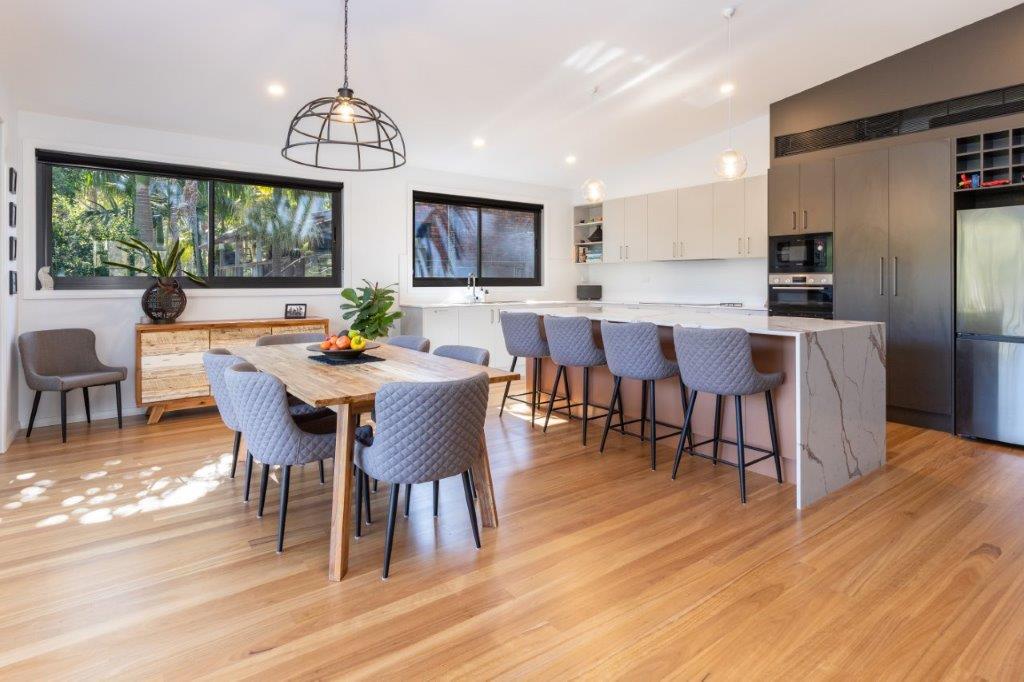
Modern laminate has improved significantly, and high-quality stone-look finishes can be genuinely hard to distinguish from natural alternatives in listing photos or at a glance during an open home. The difference shows at close range: edge profiles, texture under touch, and the depth of movement in the material still separate them from stone. Engineered stone and natural stone carry a visual weight and variation that reads as premium in a finished kitchen, and that perception matters at sale time.
For design-conscious homeowners pursuing a specific aesthetic, whether contemporary, classic, or coastal, stone offers depth and character that laminate cannot fully replicate. The right stone for a prestige kitchen goes beyond technical specs. It is as much about how the slab’s veining and tone sit within the full design, cabinetry, hardware, lighting, and all.
What Australian buyers think at an open home
In mid-range to premium Australian suburbs, buyers increasingly expect stone benchtops. A laminate surface in an otherwise renovated kitchen can read as unfinished and quietly reduce the perceived value of everything else in the room. For higher-value properties, stone signals quality and can shorten time on market and support a stronger asking price.
For properties below the local median or in the rental market, the cost difference is unlikely to be
recovered at sale. Laminate remains a sensible and presentable choice in those situations. In our experience working with clients across a range of market segments, the resale payoff from stone benchtops is most pronounced in above-median homes, where buyers arrive with specific expectations about what a renovated kitchen looks like. Below that threshold, the material choice matters less than the overall finish quality.
Which material fits your situation
Busy family kitchens
For a household with young children, high cooking frequency, and benchtops that double as homework stations, craft tables, and meal prep zones, engineered stone is the most practical long-term choice. Its non-porous surface resists staining without sealing, handles scratching better than laminate, and its 20 to 30-year lifespan means one material decision carries the kitchen through your entire time in the home. The higher upfront cost is a genuine investment in reducing friction in daily life, not just an aesthetic upgrade.
Investment properties and budget renovations
For a rental property or a house being renovated to sell quickly in a price-sensitive market, laminate is a sound, defensible choice. Modern stone-look laminates in mid-range finishes look sharp, cost a fraction of stone, and suit markets where buyers are not expecting premium materials. Compact laminate is worth considering for investment properties that need better durability than standard laminate without the full cost of engineered stone: it has no particleboard core, so it handles moisture around sink cut-outs far better than standard laminate products.
If the renovation cost cannot be recovered at sale, direct the budget toward improvements that add the most visible value for the least spend, think splashback upgrades, quality hardware, or freshly painted cabinetry rather than a premium benchtop material the market will not reward.
Design-conscious homeowners and prestige kitchens
For homeowners staying long-term, with a strong design vision and a kitchen that needs to feel genuinely premium, natural stone or high-end engineered stone is the appropriate choice. The material’s visual richness, tactile quality, and longevity align with that level of investment. Marble adds elegance but demands maintenance discipline; granite and quartzite offer durability with natural variation and significantly less upkeep. The right stone for a prestige kitchen goes well beyond technical specifications, it is about how the slab’s veining and tone work within the full design, from cabinetry colour through to hardware and lighting.
How a custom kitchen designer helps you land on the right material
Why material selection is harder than it looks online
The cost ranges and performance specs in this stone vs laminate benchtop comparison guide are solid starting points, but the right benchtop for your specific kitchen depends on layout, edge profiles, cabinetry finishes, lighting, and how the material transitions to your splashback. A benchtop that looks perfect in a showroom photo can clash with your cabinetry colour or feel out of proportion in your actual footprint. These are the details that only become apparent when someone who handles material selection every week reviews your specific space.
There is also the silica safety consideration that affects engineered stone specifically. Since the
Australian prohibition on engineered stone benchtop installation took effect on 1 July 2024, you need a cabinetmaking team who knows the current rules and builds every job around them, which is exactly how we operate at Elite Kitchens. Our team stays current with all applicable standards so your renovation is fully compliant from fabrication through to installation.
What to expect from a free design consultation
At Elite Kitchens, our free design consultation is the practical next step for any homeowner working through this decision. Whether you come into the showroom or we visit your home for an on-site measure, the session covers your existing space, how your household actually uses the kitchen, and a hands-on look at material samples in the context of the full design brief. Our 3D design preview process lets you see how your chosen benchtop material interacts with cabinetry colour, hardware, and splashback before any fabrication begins, eliminating the guesswork that leads to expensive regrets.
Get in touch with our team to book your free consultation. Come ready to think about how long you are staying, how hard the benchtop will be used, and what your local market expects from a finished kitchen.
The bottom line on stone versus laminate
Neither material wins across every situation. Laminate is smart value for rental properties, tight budgets, and lower-price market segments where the cost difference cannot be recovered at sale. Engineered stone is the practical choice for busy family kitchens and long-term owner-occupiers who want one material decision to carry the kitchen for decades. Natural stone is for design-driven projects where aesthetics and longevity are the priority, and where the homeowner is prepared to meet its maintenance requirements.
Use this stone vs laminate benchtop comparison guide as your starting point, then answer three key questions honestly: How long am I staying in this home? How hard will the benchtop be used day to day? What does my local market expect from a renovated kitchen? Bring those answers to a free consultation with the team at Elite Kitchens, and we will help you choose the right material for your specific situation,budget, and design goals.